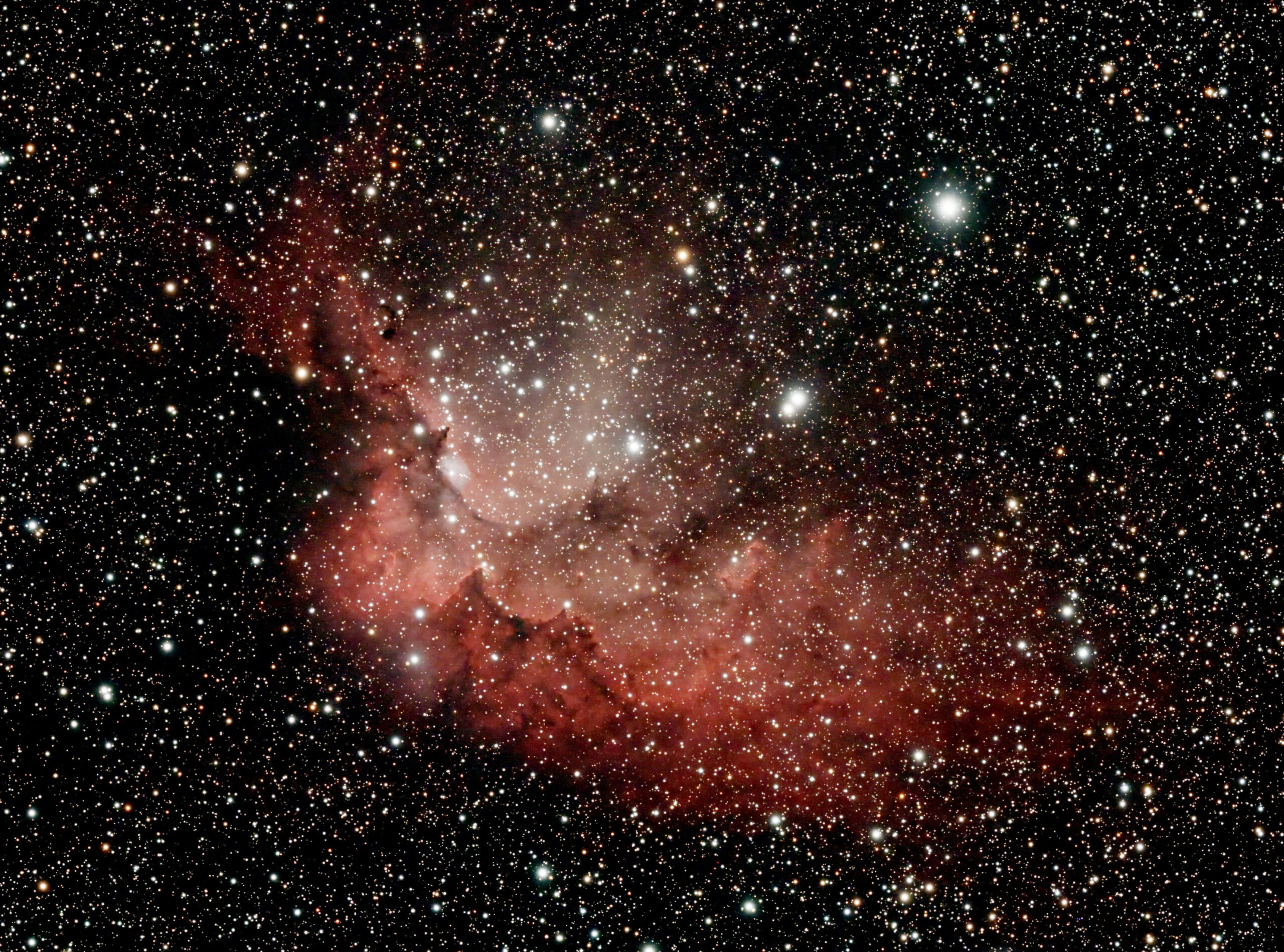
Last night, the skies above Stoer blessed us with something truly magical. After weeks of cloud cover, we finally had a crystal-clear window to capture one of the most aptly-named deep sky objects visible from our observatory: The Wizard Nebula (SH2-142). When we first saw it materializing on our screen during capture, we honestly couldn’t believe our eyes. The structure, the detail, the sheer otherworldly beauty of it all – this is exactly why we do what we do up here on the Stoer Peninsula.
What is the Wizard Nebula?
The Wizard Nebula (catalogued as SH2-142) is a faint emission nebula located roughly 8,000 light-years away in the constellation Cepheus. It’s part of a larger complex of interstellar gas and dust, where new stars are actively forming. The nebula gets its enchanting name from the distinctive shape you can see in wide-field images – it resembles a wizard in flowing robes, complete with an outstretched arm casting a spell across the cosmos.
The nebula is also part of a young open cluster NGC7380, at the centre is a binary system known as DH Cephei, this pair of massive ‘O’ type stars are the primary ionizing source for the surrounding nebula.
What you’re actually seeing is hydrogen gas being energized by radiation from young, hot stars within the cloud. This causes the gas to glow in that distinctive deep red colour (Hydrogen-alpha emission), creating these ethereal, flowing structures that look almost supernatural.
Why This Object is Absolutely Stunning
The Wizard Nebula is one of those targets that truly rewards patience and dark skies. It’s faint – really faint – which means it’s invisible to the naked eye and challenging even through most telescopes visually. But with long-exposure astrophotography, it reveals itself in spectacular fashion.
What makes SH2-142 so captivating is its intricate structure. Those billowing clouds of gas, the delicate filaments, the subtle variations in brightness and colour – it’s like watching frozen cosmic weather systems. You can almost imagine the wizard’s robes rippling in some stellar wind. The nebula also contains dark dust lanes that create dramatic contrast against the glowing gas, adding incredible depth to the image.
And here’s something that gave us goosebumps: those bright patches you can see are stellar nurseries. We’re literally looking at stars being born, a process that takes millions of years, captured in a single frame from our back garden in Assynt. It’s humbling and exhilarating at the same time.
How We Captured This Image
This image was captured from our observatory here on the Stoer Peninsula using our William Optics FLT132 apochromatic refractor paired with the ZWO ASI 2600 MC colour camera. The FLT132 is an absolute workhorse for deep sky imaging – its flat field and crisp optics really do justice to faint nebulosity like this.
We took 18 x 2-minute-second exposures, so 36 minutes of integration time. The faintness of SH2-142 meant we really needed to gather as many photons as possible, and our exceptional dark skies here in Assynt made all the difference. Light pollution would have drowned out this level of detail entirely – this is the kind of target that simply demands truly dark skies.
After capture, we stacked all the frames in PixInsight to reduce noise and bring out the signal, then did final processing adjustments in Lightroom to enhance the contrast and colour. The processing workflow for emission nebulae is always a delicate balance – you want to bring out those faint structures without creating an artificial look.
The Magic of Stoer’s Dark Skies
We genuinely cannot overstate how crucial our location is for images like this. The Stoer Peninsula sits within one of the darkest regions of mainland Scotland, and on a clear night like last night, the Milky Way casts shadows. That darkness is what allows us to capture the subtle details in objects like the Wizard Nebula – details that would be completely lost under light-polluted skies.
If you’re interested in experiencing these incredible skies for yourself, we run bespoke stargazing events where you can see objects like this through our telescopes and learn about what makes our corner of Scotland so special for astronomy.
We’re also thrilled to be part of the growing astronomy community here in Assynt. If you’re local or visiting the area regularly, do consider joining the Assynt Astronomy Club – we meet regularly to share our passion for the night sky, and we’d love to welcome new members.
For now, we’re keeping our fingers crossed for more clear nights. There’s a growing list of targets calling to us from the autumn sky, and after last night’s success with the Wizard, we’re more motivated than ever to keep capturing the wonders above Stoer.
Watch this space!
Leave a Reply