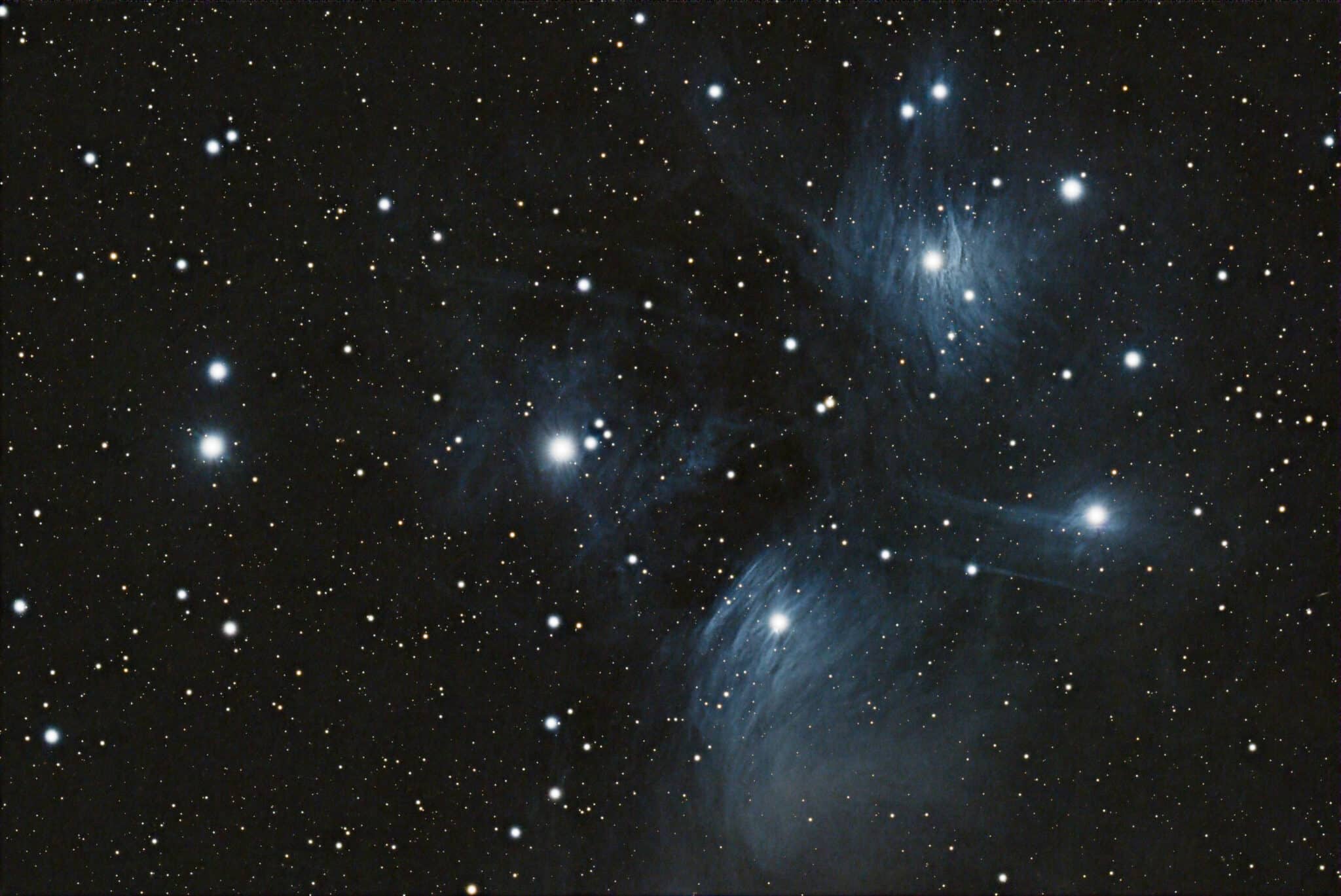
Here’s a recent capture of one of the most recognizable deep-sky objects visible from the northern hemisphere: the Pleiades star cluster, also known as M45 or the Seven Sisters.
This stunning open cluster has been captivating observers for millennia, and for good reason. Let me share what makes this celestial gem so compelling, along with some science behind what you’re seeing in this 120-minute exposure.
What Is the Pleiades?
The Pleiades is an open star cluster—a group of stars born from the same molecular cloud, still gravitationally bound together as they drift through space. Located in the constellation Taurus, M45 contains over 1,000 confirmed members, though only six to nine stars are typically visible to the naked eye under good conditions.
What immediately strikes you in longer exposures like this one is the nebulosity—those wispy blue clouds threading between the stars. This isn’t leftover material from the cluster’s formation. The Pleiades is actually passing through an unrelated dust cloud, and the starlight is illuminating it through reflection. This makes M45 a reflection nebula, where dust particles scatter blue light more efficiently than red, giving it that distinctive color.
A Cluster as Old as Humanity
Here’s where it gets interesting: the Pleiades hasn’t been “discovered” in the conventional sense. It’s been observed throughout human history. Ancient cultures around the world—from the Greeks and Aboriginal Australians to the Māori and various Indigenous peoples of the Americas—all recorded and mythologized this cluster.
Charles Messier catalogued it as M45 in 1769, though he acknowledged it was known since antiquity. The first telescopic observations were made by Galileo in 1610, who counted 36 stars rather than the seven visible to the naked eye.
Standing here in the northwest Highlands’ pristine dark skies, you can understand why our ancestors paid such close attention to it. On a clear winter evening, the Pleiades commands attention.
The Numbers Behind the Beauty
Let’s talk scale. The Pleiades sits approximately 444 light-years from Earth—relatively close in astronomical terms. The cluster itself spans about 17.5 light-years across, though the area of nebulosity we see extends even further.
At roughly 100 million years old, these are young stars. For context, our Sun is 4.6 billion years old. The brightest stars in the Pleiades are hot, blue B-type stars still in their adolescence, burning through their hydrogen fuel at a prodigious rate.
The cluster has an apparent size of about 110 arcminutes—nearly four times the width of the full Moon. This makes it an excellent target for wide-field imaging setups like mine.
Scientific Significance
The Pleiades isn’t just pretty—it’s scientifically valuable. As one of the nearest star clusters, astronomers use it as a benchmark for understanding stellar evolution. Because all the stars formed at roughly the same time from the same material, the Pleiades serves as a natural laboratory for studying how stars of different masses evolve.
The cluster has also been crucial for calibrating the cosmic distance ladder. Precise distance measurements to the Pleiades, particularly those from the Gaia space telescope, help refine our understanding of distances throughout the universe.
More recently, astronomers have been studying brown dwarfs within the cluster—objects too small to sustain hydrogen fusion but larger than planets. The Pleiades contains numerous brown dwarfs, helping us understand the boundary between stars and planets.
Capturing the Seven Sisters
For this image, I used my William Optics FLT132 refractor paired with a ZWO ASI2600MC camera—a setup that provides a good balance between field of view and resolution for extended objects like M45.
I captured 60 exposures of 120 seconds each, totaling two hours of integration time. This might seem excessive for such a bright object, but the additional exposure time reveals the faint nebulosity and fainter cluster members that would otherwise be lost.
The processing was done in PixInsight for the heavy lifting—stacking, calibration, and bringing out the nebulosity—with final adjustments in Lightroom to balance the overall presentation. The challenge with the Pleiades is managing the bright core stars while preserving detail in the surrounding nebula.
Observing the Pleiades Yourself
One of the great things about M45 is its accessibility. You don’t need sophisticated equipment to enjoy it. The cluster is visible to the naked eye from autumn through spring in the northern hemisphere, appearing as a small dipper-shaped smudge in Taurus.
Binoculars transform the view, revealing dozens of stars. Even a small telescope begins to show the brighter stars’ blue color and hints of nebulosity under dark skies.
If you’re interested in learning how to observe or photograph objects like the Pleiades, I run sessions through the Assynt Astronomy Club, where we explore both the practical and scientific aspects of amateur astronomy.
For those wanting a more tailored experience, I also offer bespoke astronomy events from the observatory here on Stoer, where we can dive deeper into specific targets and imaging techniques.
Why M45 Matters
The Pleiades reminds us of our connection to the cosmos. The same cluster that helped ancient sailors navigate is now helping modern astronomers understand stellar physics. The iron in our blood was likely forged in stars similar to those in the Pleiades.
From the dark skies of the northwest Highlands, where light pollution is minimal and the atmosphere is often exceptionally clear, objects like M45 appear much as they did to observers thousands of years ago. That continuity—that connection across time—is something special.
Watch this space…
Leave a Reply