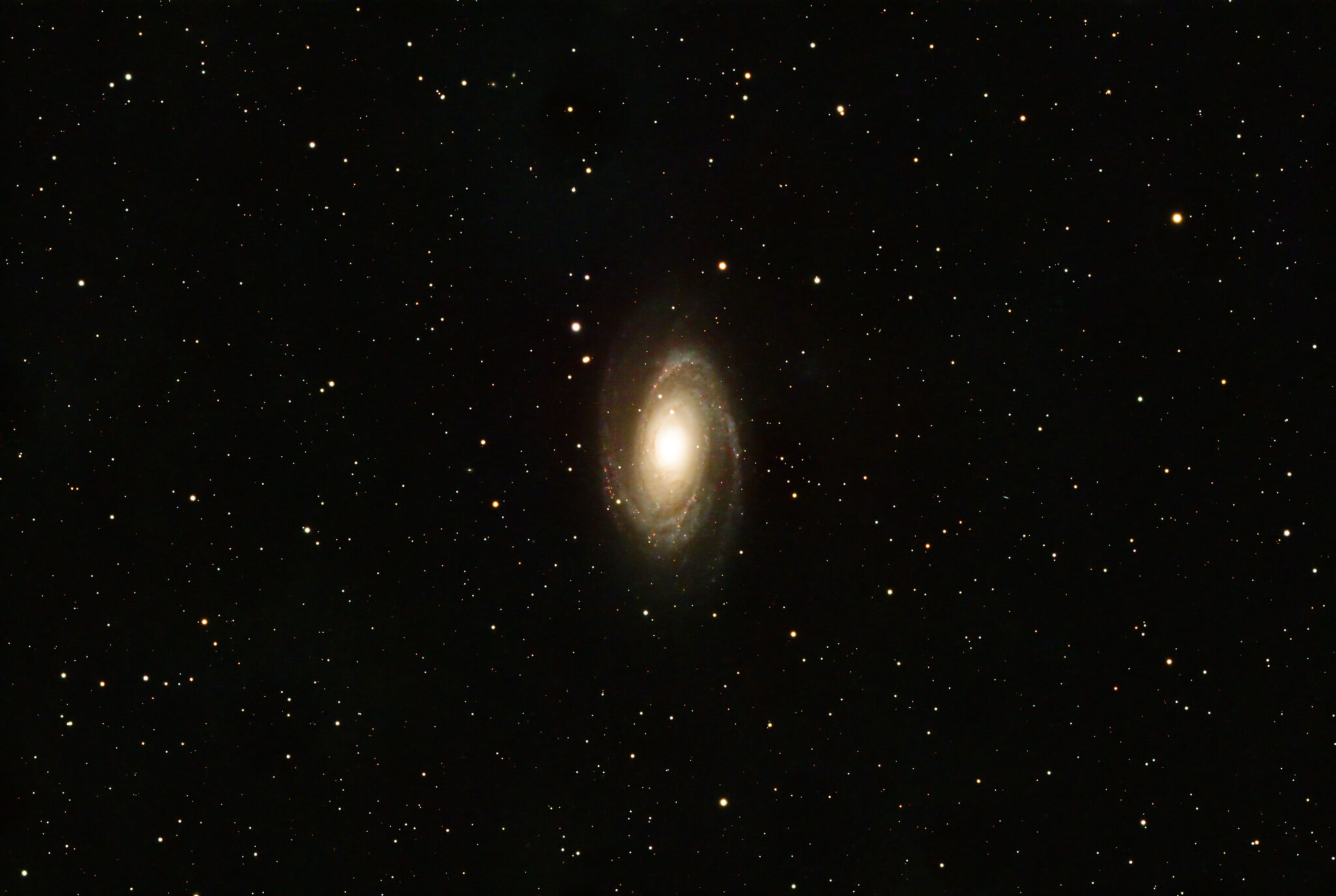
Recently I pointed my William Optics FLT132 towards one of the northern sky’s most rewarding targets: M81, better known as Bode’s Galaxy. After capturing 26 frames at 120 seconds each with the ZWO ASI2600MC camera—just over 52 minutes of total exposure time—I’m pleased to share the results here.
What is M81?
M81 is a grand design spiral galaxy located in the constellation Ursa Major. At approximately 11.8 million light-years from Earth, it’s one of the brighter galaxies visible from the northern hemisphere, making it an excellent target for astrophotography—even from the occasionally cloudy skies here on the Stoer Peninsula.
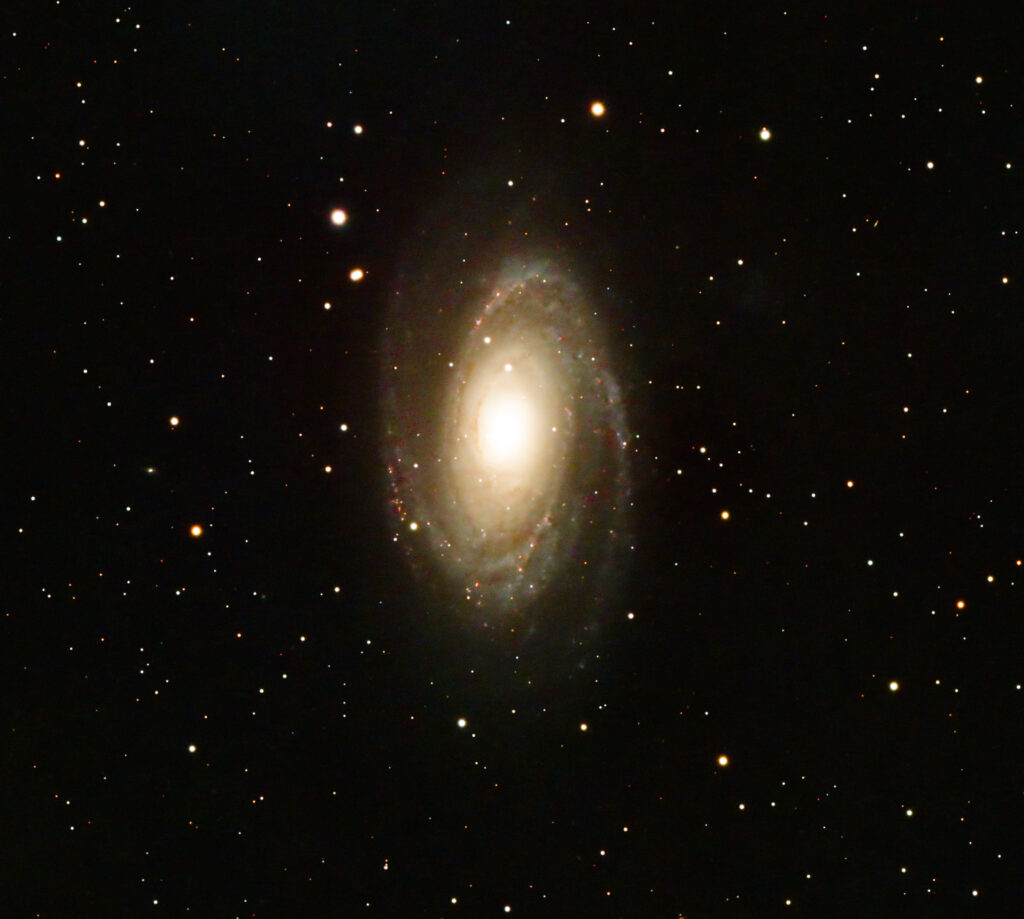
What makes M81 particularly photogenic is its well-defined spiral structure. The arms are rich with star-forming regions, while the core glows with the light of billions of older stars. Through the telescope, it presents itself at a slight angle, giving us a three-dimensional perspective of its structure.
Discovery and Historical Significance
Johann Elert Bode discovered M81 on December 31, 1774—quite the Hogmanay find. His compatriot, Johann Koehler, had actually spotted it a few days earlier, but Bode’s detailed observations gave the galaxy his name. Charles Messier later added it to his famous catalogue, where it became the 81st entry.
Interestingly, Bode initially couldn’t determine whether he was looking at a nebula or a cluster of faint stars—a question that wouldn’t be resolved until Edwin Hubble’s observations in the 1920s proved these “spiral nebulae” were actually separate galaxies far beyond our own Milky Way.
The Numbers
M81 spans approximately 90,000 light-years in diameter—slightly smaller than our Milky Way’s estimated 100,000 light-years. It contains around 250 billion stars and has an apparent magnitude of 6.9, which places it just at the threshold of naked-eye visibility under exceptionally dark skies like those we’re fortunate to have in the Highlands.
The galaxy is receding from us at roughly 34 kilometres per second, though this is partially offset by our own motion through space.
Scientific Importance Today
M81 isn’t just a pretty face. It’s the dominant member of the M81 Group, a collection of 34 galaxies including its close companion M82 (the Cigar Galaxy). The gravitational interaction between M81 and M82 has triggered intense star formation in M82, making this pair a natural laboratory for studying galactic interactions.
In 1993, M81 hosted a Type Ia supernova (SN 1993J), one of the brightest supernovae observed in recent decades. This event provided crucial data for calibrating the cosmic distance ladder—the series of methods astronomers use to measure distances to far-off objects in the universe.
More recently, observations of Cepheid variable stars in M81 by the Hubble Space Telescope have refined our measurements of the galaxy’s distance, contributing to our understanding of the universe’s expansion rate.
Capturing M81 from Stoer
The relatively short 120-second sub-exposures were chosen to balance detail capture with the practical realities of imaging from a coastal location. Even with our excellent dark skies, wind and atmospheric moisture can affect longer exposures.
Processing in PixInsight focused on bringing out the spiral arm detail and the subtle colour differences between the blue star-forming regions and the yellow-orange core. Final adjustments in Lightroom helped manage the colour balance and overall presentation.
The FLT132’s 132mm aperture and 925mm focal length (f/7) provides an ideal combination of light-gathering ability and field of view for this type of deep-sky object. The ASI2600MC’s 26-megapixel sensor captures enough resolution to show fine structural details in the spiral arms.
Observing M81 Yourself
If you’re interested in learning more about observing or photographing objects like M81, we run bespoke astronomy events here at the observatory. Whether you’re a complete beginner or looking to develop your astrophotography skills, we can tailor sessions to your interests.
For those local to Assynt and the surrounding area, consider joining our Assynt Astronomy Club, where we regularly observe and discuss targets like this throughout the year.
M81 is well-placed for observation from autumn through spring in the northern hemisphere, reaching its highest point in the sky during March and April. It sits near the border between Ursa Major and Camelopardalis.
Watch this space…
Leave a Reply