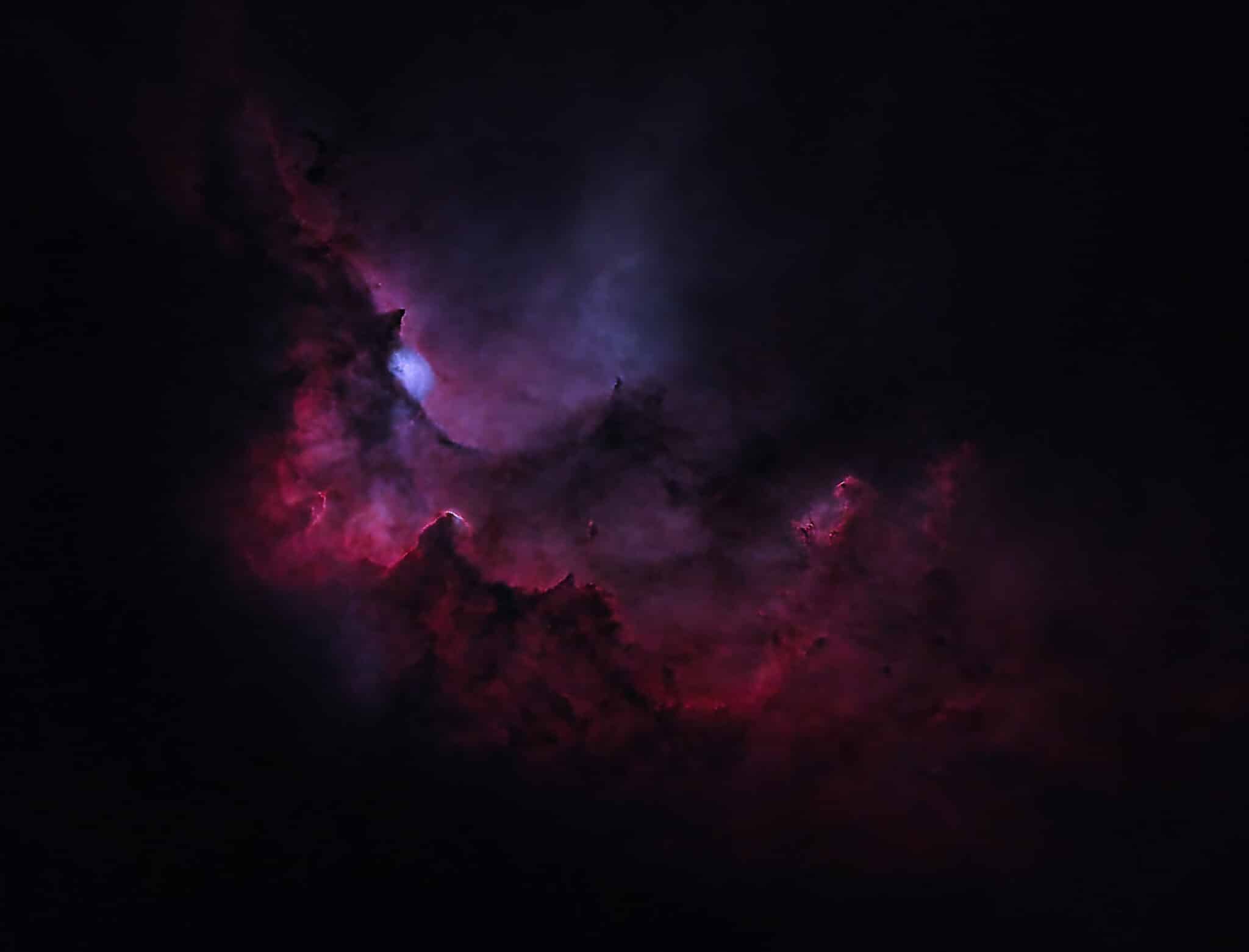
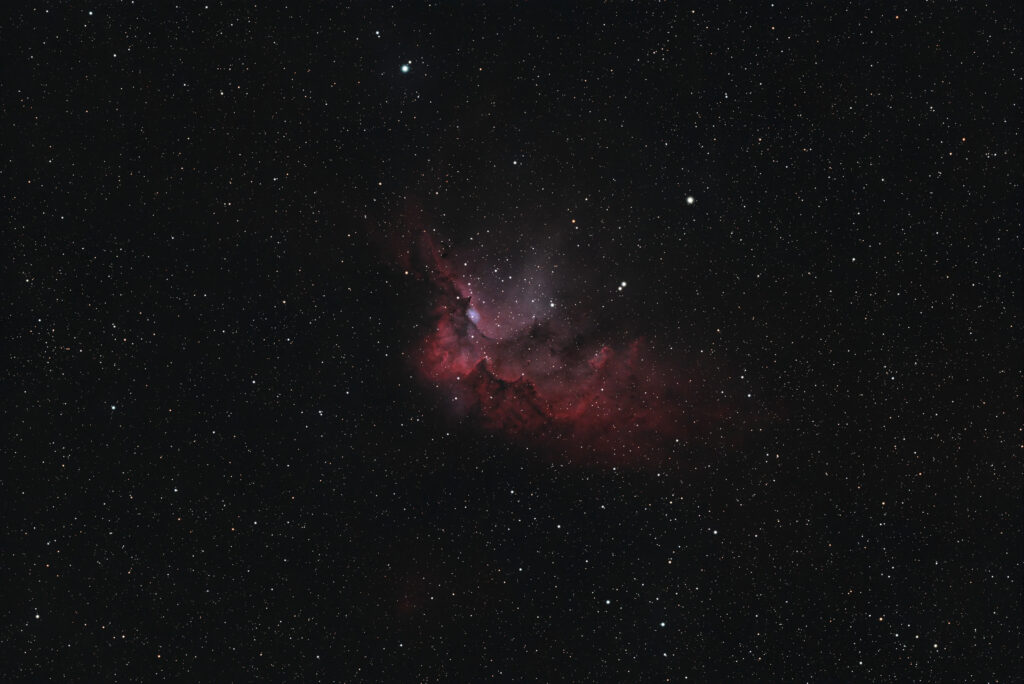
Halloween night brought clear skies to the Stoer Peninsula – a rare gift in the northwest Highlands. While most were handing out sweets, I was capturing something far more ancient: the Wizard Nebula, officially catalogued as SH2-142 and NGC 7380.
What Is the Wizard Nebula?
The Wizard Nebula is an emission nebula located in the constellation Cepheus. It’s an active star-forming region where new stars are being born within vast clouds of hydrogen gas. The nebula gets its informal name from its resemblance to a wizard figure, complete with what looks like outstretched arms and a pointed hat – though I’ll admit, astronomical pareidolia requires a bit of imagination.
This particular image represents 20 exposures of 120 seconds each, stacked and processed with the stars removed to reveal the intricate structure of the nebulosity itself. The dominant red colouring comes from ionised hydrogen (H-II), while the blueish regions show oxygen III (OIII) emission. These different wavelengths tell us about the temperature, composition, and energetic processes happening within the cloud.
The Stars Behind the Magic
What makes this nebula particularly interesting from a scientific perspective is its primary ionising source: a pair of O-type stars in a double-lined spectroscopic binary system. These massive, hot stars pump out enormous amounts of ultraviolet radiation, which strips electrons from the surrounding hydrogen atoms – a process called ionisation. When those electrons recombine with hydrogen nuclei, they emit the characteristic red glow we see in H-alpha.
I’ve been studying these binary systems as part of my Open University coursework over the past few weeks, so capturing this object felt especially relevant. O-type stars are rare – they represent less than 0.00003% of main sequence stars – and they don’t live long, typically only a few million years. The fact that we’re seeing one (technically two) means this is a relatively young system.
Discovery and Basic Facts
The Wizard Nebula was discovered in 1787 by Caroline Herschel, sister of astronomer William Herschel. Caroline was an accomplished astronomer in her own right, discovering eight comets and several deep-sky objects during her career. She was the first woman to be paid for scientific work in Britain and the first to hold a government position in England.
Here are the key statistics:
- Distance: Approximately 8,500 light-years from Earth
- Size: Approximately 40 light-years in diameter
- Age: The open cluster at its heart (NGC 7380) is estimated to be between 4-12 million years old
- Location: Right ascension 22h 47m, Declination +58° 07′ in Cepheus
Scientific Significance
Star-forming regions like the Wizard Nebula are crucial laboratories for understanding stellar evolution. By studying these nebulae, astronomers can observe the earliest stages of star formation, investigate how massive stars affect their surroundings, and understand the chemical enrichment of the interstellar medium.
The nebula’s relatively close distance (in astronomical terms) and active star formation make it an excellent target for studying triggered star formation – the process where the intense radiation and stellar winds from massive stars compress nearby gas clouds, potentially initiating the collapse that leads to new star formation.
Imaging from the Stoer Peninsula
This image was captured using my William Optics FLT132 refractor paired with a ZWO ASI2600MC camera. The FLT132’s 132mm aperture and 925mm focal length provide an excellent balance of field of view and resolution for nebulae of this size. The ASI2600MC’s back-illuminated sensor and 26-megapixel resolution allow for detailed captures even in our challenging Highland weather conditions.
Processing was done in PixInsight for the heavy lifting – calibration, stacking, and starless processing – followed by final adjustments in Lightroom. The starless technique, where stars are computationally removed from the image, helps reveal the nebula’s delicate structure without the visual distraction of foreground stars.
Even with our exceptional dark skies here on Stoer, these faint emission nebulae require patience and multiple exposures to build up sufficient signal-to-noise ratio.
Observing the Wizard Yourself
While the Wizard Nebula is spectacular through a telescope with proper filters or in long-exposure astrophotography, it’s essentially invisible to the naked eye. It requires a telescope of at least 6 inches aperture and a narrowband filter (particularly H-alpha) to see visually, and even then, you’ll only see a faint glow.
If you’re interested in observing objects like this yourself, our Assynt Astronomy Club meets regularly to share observations, techniques, and the occasional clear Highland night. We also offer bespoke events where you can observe deep-sky objects through proper equipment and learn the techniques behind astrophotography.
Final Thoughts
The Wizard Nebula reminds us that star formation isn’t a relic of the distant past – it’s happening now, constantly, throughout our galaxy. Those glowing clouds of gas are stellar nurseries, and within them, planetary systems may be forming that could, billions of years from now, harbour their own astronomers looking back at us.
Though I captured this image on Halloween, I’m only posting it now on 22 November – a reminder that clear skies and data processing don’t always align with our calendars. That’s the reality of astronomy from the Scottish Highlands: you capture when conditions allow, and you share when the processing is complete.
Watch this space…
Leave a Reply