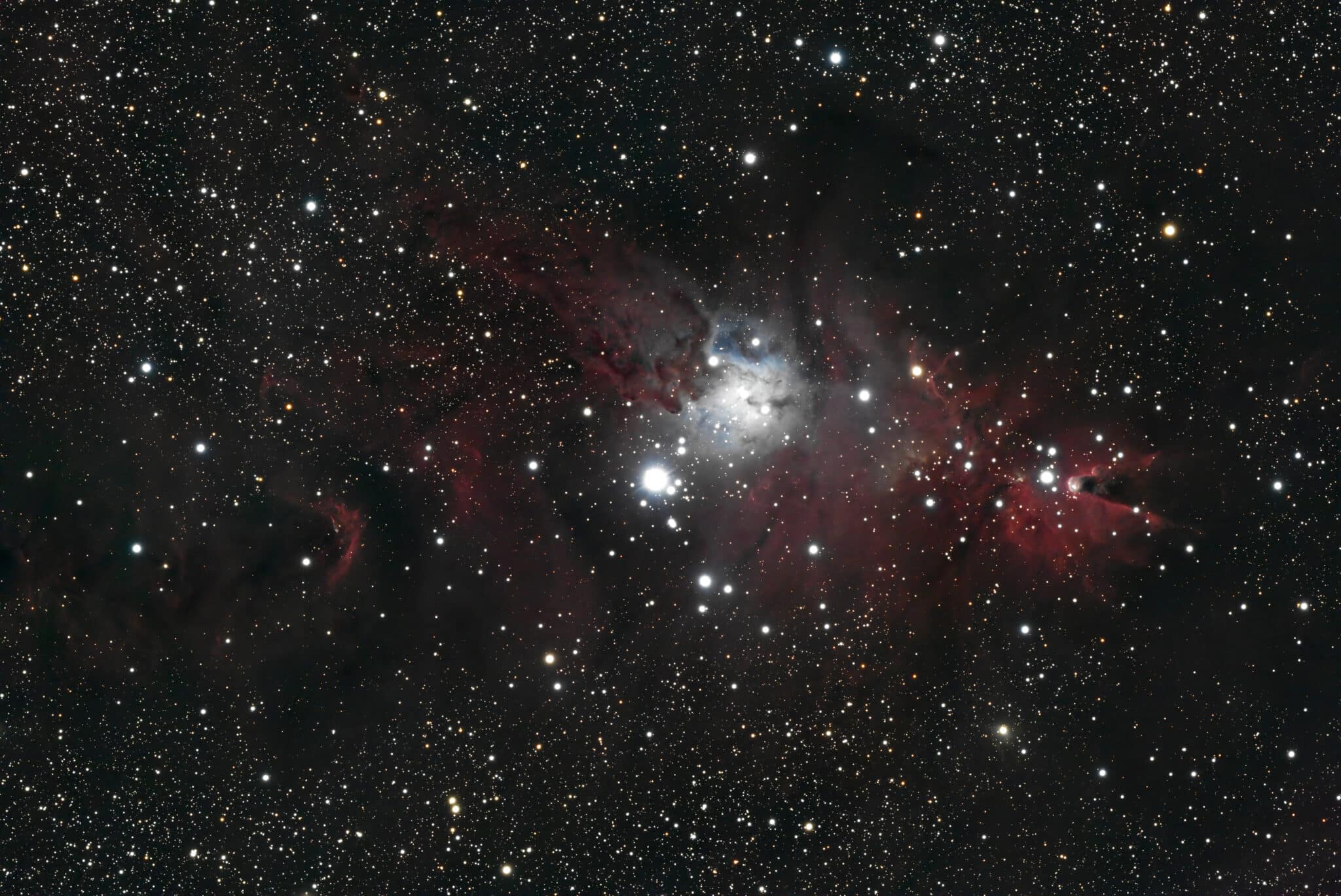
Last night, I reprocessed one of my favourite winter targets from earlier this year – NGC 2264, better known as the Christmas Tree Cluster and Cone Nebula complex. This stellar nursery in the constellation Monoceros never fails to deliver spectacular detail, and after spending some time back in PixInsight with the data, I’m pleased to share the results.
What Am I Looking At?
NGC 2264 is an emission nebula approximately 2,600 light-years from Earth. It’s actually a combination of three distinct features: the Cone Nebula (the dark intrusion at the top), the Christmas Tree Cluster (an open cluster of young stars), and the surrounding hydrogen-rich nebulosity that glows that characteristic red in HII wavelengths. The “Christmas Tree” shape is formed by the cluster itself – flip the image upside down and you’ll see it clearly, with the Cone Nebula forming the tree’s top.
This image represents 60 exposures of 120 seconds each – two hours of total integration time – captured on March 26th, 2025 from my observatory here on the Stoer Peninsula. The dark skies of Assynt make targets like this genuinely accessible, even with the challenges of Scottish weather.
Discovery and Historical Context
William Herschel discovered the Cone Nebula portion of NGC 2264 in 1785, though he couldn’t have seen the full extent of what we can capture today. The Christmas Tree Cluster itself was actually catalogued earlier by his sister Caroline in 1783, making this a family affair. It’s worth noting that visual observation reveals primarily the cluster stars – the nebulosity requires long-exposure imaging to bring out properly.
Scale and Distance
At 2,600 light-years distant, NGC 2264 spans roughly 20 light-years across. To put that in perspective, that’s approximately 5 times the distance from our Sun to Proxima Centauri, our nearest stellar neighbour. The Cone Nebula itself is a massive pillar of gas and dust approximately 7 light-years long – enormous by any measure, yet appearing relatively small in our field of view due to the distance.
Why This Matters to Modern Science
NGC 2264 is classified as an active star-forming region, making it invaluable for studying stellar evolution. The cluster contains stars less than 5 million years old – infants in cosmic terms. Observations in infrared wavelengths (particularly from Spitzer and James Webb Space Telescope) have revealed protostars still forming within the dense molecular clouds, giving us direct evidence of star birth in progress.
The Cone Nebula specifically demonstrates how stellar winds from young, hot stars sculpt their surrounding material. The “cone” shape is formed by intense ultraviolet radiation from nearby stars evaporating the pillar’s surface, creating the distinctive structure we see. This process is similar to what we observe in the more famous Pillars of Creation in M16.
The Imaging Setup
This image was captured using my William Optics FLT132 APO refractor paired with a ZWO ASI2600MC camera – a one-shot colour sensor that captures all wavelengths simultaneously. The 132mm aperture and 925mm focal length provide an ideal field of view for this target, framing the entire complex comfortably.
Processing was completed in PixInsight for calibration, registration, integration, and the bulk of stretching and enhancement work. Final touches – including some selective colour balancing and minor contrast adjustments – were done in Lightroom. The Ha-dominant emission from this nebula comes through strongly even with the OSC sensor, though narrowband imaging would reveal additional structure in the surrounding regions.
Observing NGC 2264 Yourself
NGC 2264 is positioned in Monoceros, east of Orion and north of Sirius. It’s a winter/spring target for northern hemisphere observers. Visually, you’ll spot the cluster easily with binoculars – look for a triangular arrangement of 6th to 8th magnitude stars. The nebulosity itself requires dark skies, a telescope of at least 6 inches aperture, and an HII or OIII filter to see visually.
From the Highlands, I’ve found mid-winter through early spring provides the best imaging opportunities, when Monoceros reaches good altitude in the evening sky. If you’re interested in learning more about targets like this or developing your own astrophotography skills, I run bespoke astronomy events right here from the observatory.
For local residents and regular visitors, the Assynt Astronomy Club meets regularly to discuss observations, share images, and plan viewing sessions. It’s a good bunch, and newcomers are always welcome.
Technical Notes
- Target: NGC 2264 (Christmas Tree Nebula, Cone Nebula, Christmas Tree Cluster)
- Object Type: Emission nebula + open cluster in Monoceros
- Integration Time: 60 × 120s = 2 hours
- Capture Date: March 26th, 2025 (reprocessed)
- Telescope: William Optics FLT132 (132mm f/7 APO)
- Camera: ZWO ASI2600MC
- Processing: PixInsight, Adobe Lightroom
- Location: Stoer Peninsula, Scottish Highlands
The skies are starting to clear again this week, so I’m hoping to get some data on a few autumn galaxies.
Watch this space…
Leave a Reply