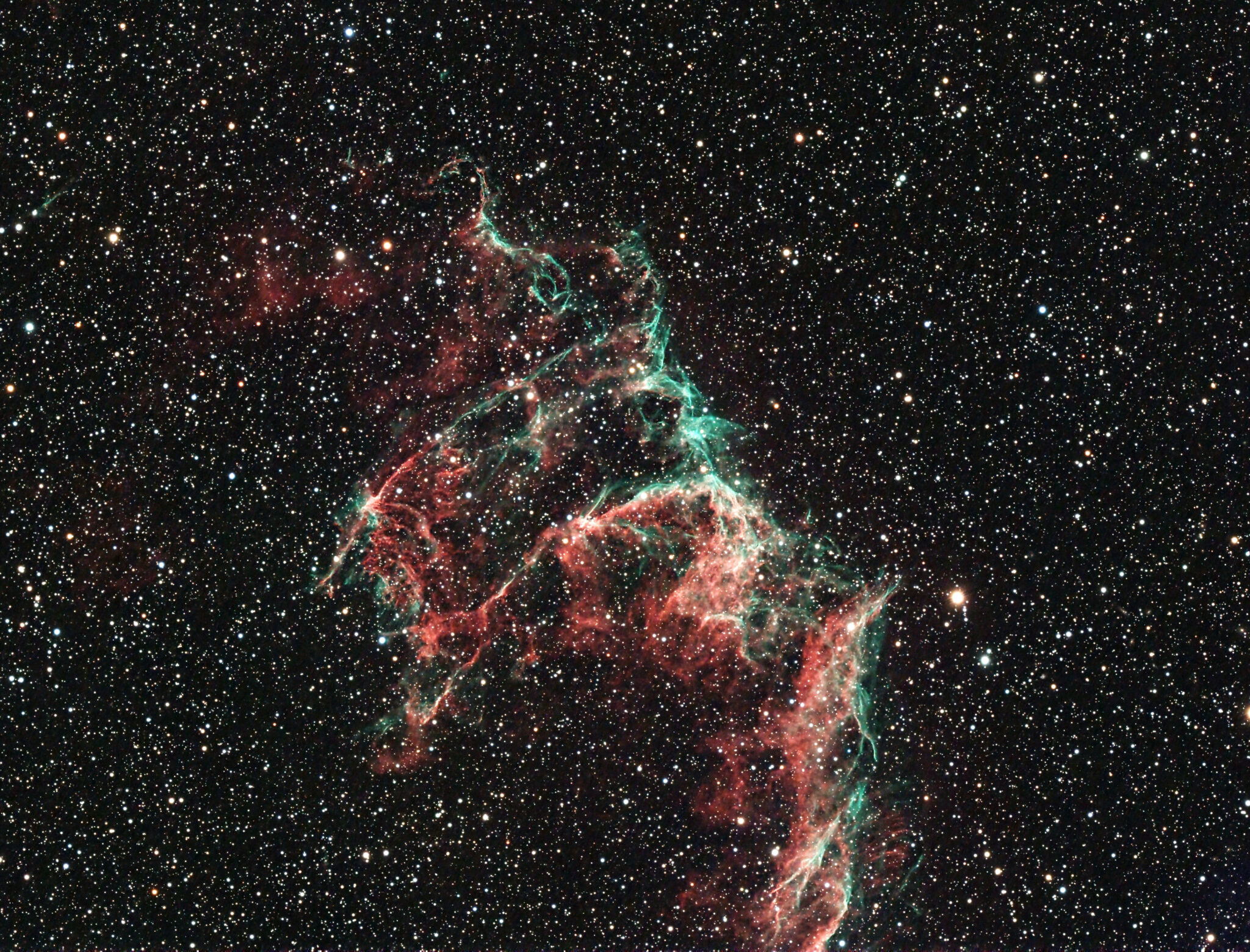
Last night from my observatory here on the Stoer Peninsula, I captured something that’s been on my imaging list for months: SH2-103, a lesser-known emission nebula in Cygnus. After 20 exposures of 120 seconds each with my William Optics FLT132 and ZWO ASI2600MC, this faint cloud of ionised hydrogen finally revealed itself.
What is SH2-103?
SH2-103 is an emission nebula catalogued by American astronomer Stewart Sharpless in his 1959 survey of HII regions. It’s part of the larger Cygnus X complex, a massive star-forming region that stretches across the constellation of Cygnus the Swan. Like its more famous neighbour the Veil Nebula (which I shot last year under similar conditions), SH2-103 glows primarily in hydrogen-alpha light as ultraviolet radiation from nearby hot stars strips electrons from hydrogen atoms.
The Numbers
SH2-103 sits approximately 4,500 light-years from Earth and spans roughly 45 light-years across. For context, that’s about 270 trillion miles in diameter. Stewart Sharpless identified it using photographic plates at Mount Wilson and Palomar Observatories as part of his systematic catalogue of 313 HII regions visible from the northern hemisphere.
What struck me while processing this image in PixInsight and Lightroom was how similar the structure appears to the Veil Nebula I captured last year. Both show that characteristic filamentary structure where shock waves compress the interstellar medium. But while the Veil is a supernova remnant—the scattered remains of a star that exploded—SH2-103 represents active star formation still in progress.
Why Image SH2-103?
From a scientific perspective, emission nebulae like SH2-103 are laboratories for understanding stellar birth. The glowing hydrogen traces where new stars are ionising their surroundings, and the complex structures reveal how stellar winds and radiation shape the gas clouds. The Cygnus X region, where SH2-103 resides, is one of the most active star-forming regions in our part of the galaxy.
From a practical imaging perspective, it’s challenging. At magnitude 10, it’s faint. The northwest Highlands help considerably here—our dark skies provide the contrast needed to tease out these subtle structures. The same sky conditions that let me capture the delicate wisps of the Veil Nebula make objects like SH2-103 accessible.
The Technical Side
The FLT132’s 132mm aperture and f/7 focal ratio provided good light-gathering power while keeping the exposure times manageable at 120 seconds. The ASI2600MC’s back-illuminated sensor handled the faint nebulosity well, even in hydrogen-alpha wavelengths where one-shot colour cameras historically struggle. Total integration time was 40 minutes—not long by modern astrophotography standards, but sufficient for this relatively bright nebula.
Processing followed my standard workflow: calibration and integration in PixInsight, then final adjustments in Lightroom to bring out the subtle colour variations where hydrogen-alpha red transitions to oxygen-III blue-green at the nebula’s edges.
Modern Significance
While Sharpless’s catalogue is over 60 years old, these HII regions remain scientifically relevant. Modern surveys using infrared and radio telescopes have revealed protostars embedded within SH2-103’s gas clouds. These observations help astronomers understand the initial mass function—the distribution of masses in newly formed stars—which affects everything from galaxy evolution to planet formation rates.
If you’re interested in learning more about emission nebulae and how we observe them from the Highlands, consider joining the Assynt Astronomy Club where we discuss current observations and imaging projects. For those wanting a more personalised experience, I also offer bespoke events from the observatory where we can explore objects like SH2-103 in real-time.
Next on the imaging schedule: returning to the eastern Veil to capture the Witch’s Broom section with the same equipment setup. The comparison between these star-forming and star-death regions should prove instructive.
Watch this space…
Leave a Reply