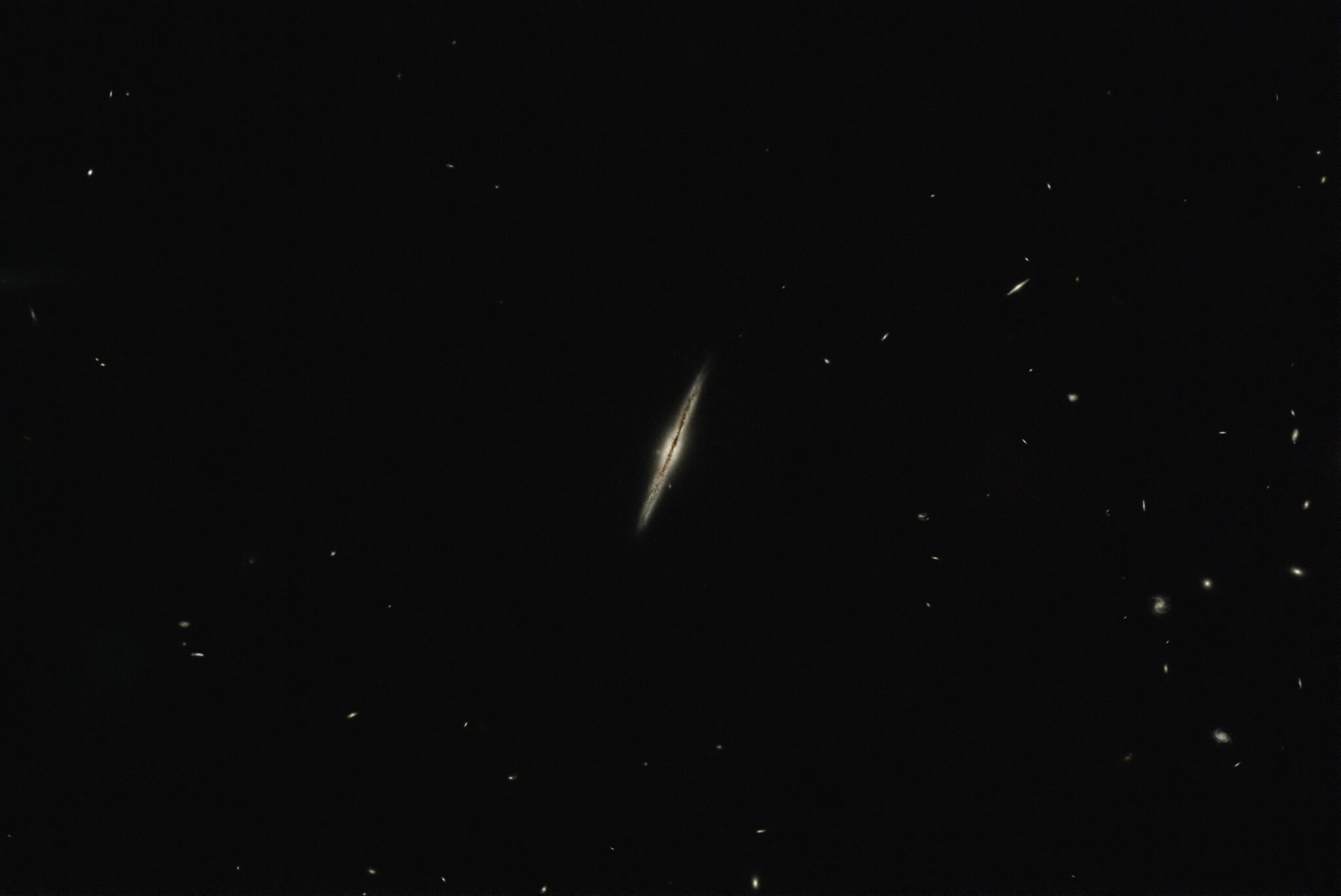
Last night, I managed to capture one of my favourite edge-on galaxies from the observatory here on the Stoer Peninsula: NGC 891, sometimes called the Silver Silver Galaxy. With 50 exposures at 120 seconds each (that’s a total of 100 minutes of data), I’m really pleased with how this one turned out.
What is NGC 891?
NGC 891 is a spiral galaxy located in the constellation Andromeda, presented to us almost perfectly edge-on. This orientation gives us a rare side-view perspective of a galaxy structure remarkably similar to our own Milky Way. What you’re seeing in the image is a bright galactic disc bisected by prominent dust lanes – those dark streaks running through the core are clouds of interstellar dust blocking the light from stars behind them.
Discovery and History
NGC 891 was discovered by William Herschel on 6 October 1784, using his 18.7-inch reflector telescope. Herschel was systematically surveying the northern sky at the time, cataloguing hundreds of deep-sky objects that would later form the basis of the New General Catalogue (NGC). This galaxy earned its alternative name, the Outer Limits Galaxy, from its appearance in the opening credits of the 1960s science fiction television series “The Outer Limits”.
The Numbers
NGC 891 sits approximately 30 million light-years from Earth – relatively close in cosmic terms. The galaxy spans roughly 100,000 light-years in diameter, making it comparable in size to the Milky Way. When you’re looking at this image, you’re seeing light that left this galaxy around the time early primates were evolving on Earth.
Why NGC 891 Matters to Modern Astronomy
This galaxy serves as an important template for understanding galactic structure, including our own. Because we’re inside the Milky Way, we can’t easily see its overall structure – it’s like trying to understand the layout of a building when you’re standing in one of its rooms. NGC 891’s edge-on orientation lets astronomers study spiral galaxy anatomy in detail: the thin stellar disc, the prominent dust lanes, the central bulge, and the extended halo.
Recent studies of NGC 891 have revealed complex filamentary structures extending above and below the galactic plane – evidence of supernova-driven outflows that cycle material between the disc and the halo. This process is crucial for understanding how galaxies regulate their star formation and chemical evolution over cosmic time.
Capturing the Image
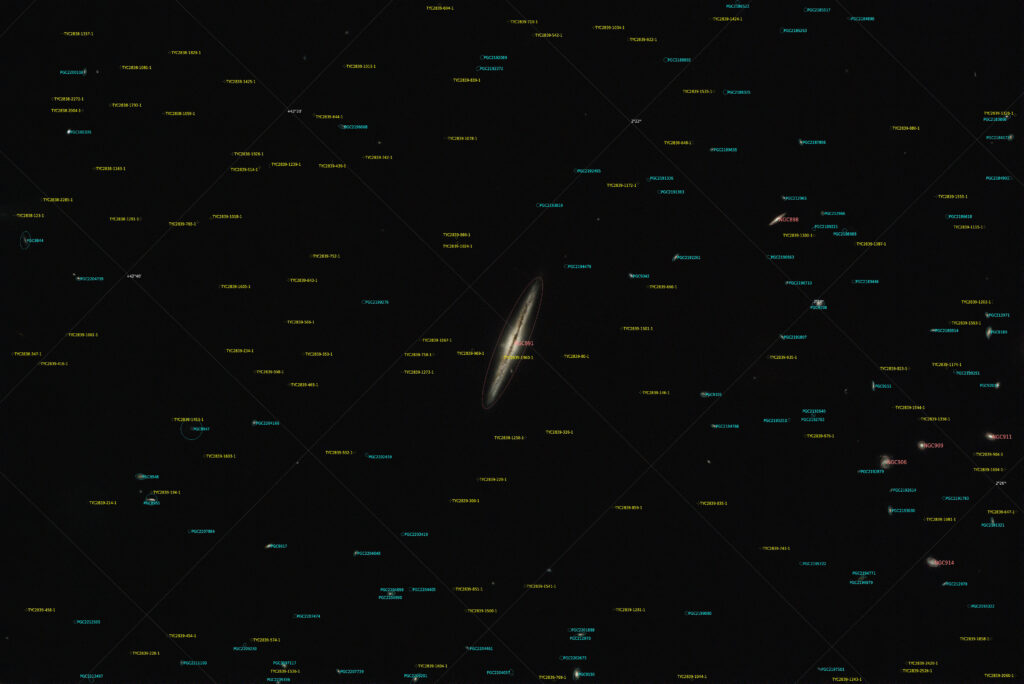
I shot this from my home observatory using the William Optics FLT132 refractor paired with the ZWO ASI2600MC camera. The FLT132’s 132mm aperture and 925mm focal length gives excellent detail on extended objects like this, whilst the ASI2600MC’s 26-megapixel sensor captures plenty of resolution.
The 50 × 120-second exposures were stacked and processed in PixInsight, where I stretched the data to bring out the faint outer regions and dust lanes without blowing out the bright core. Final touches were done in Lightroom to optimise contrast and colour balance.
Observing NGC 891 from the Northwest Highlands
One of the significant advantages of being based here on the Stoer Peninsula is the dark sky. NGC 891 is a moderately bright galaxy at magnitude 9.9, but capturing the subtle dust lanes and faint halo requires genuinely dark skies free from light pollution. Our location provides exactly that. If you’re interested in experiencing these skies yourself, we offer bespoke astronomy events where you can observe objects like this through quality equipment.
Planning Your Own Observations
NGC 891 is visible from the UK throughout autumn and winter, reaching its highest point around midnight in October. You’ll need dark skies to see it well – magnitude 9.9 means it’s invisible to the naked eye and appears as only a faint smudge in small telescopes. Long-exposure astrophotography really brings out the detail.
Final Thoughts
NGC 891 reminds us that we live in a galaxy probably quite similar to this one – a vast disc of stars, gas, and dust, rotating through space. Edge-on galaxies give us perspective on our cosmic home in a way few other objects can.
I’ll be targeting more edge-on galaxies this season as conditions allow.
Watch this space…

Leave a Reply to merge plants Cancel reply